One day, an envelope arrived in the mail.
The sender is “Direct Publishing.” What's inside seems to be a guide to a sales copy book.
To be honest, at first I thought “see you again.” But somehow I opened it. Somehow I started reading it. And before I knew it, I had read it until the end.
I finished reading it and felt a creep in my back.
This has been “designed” from beginning to end.
From the moment I opened the envelope, my brain was dancing in someone's palm.
Today, I'm going to dissect this DM in pieces, one sheet at a time from the viewpoint of behavioral economics. A treasure trove of techniques any marketer can steal. If you are a consumer, you will be able to understand how “manipulated” you are.
[Envelope] The game starts before opening
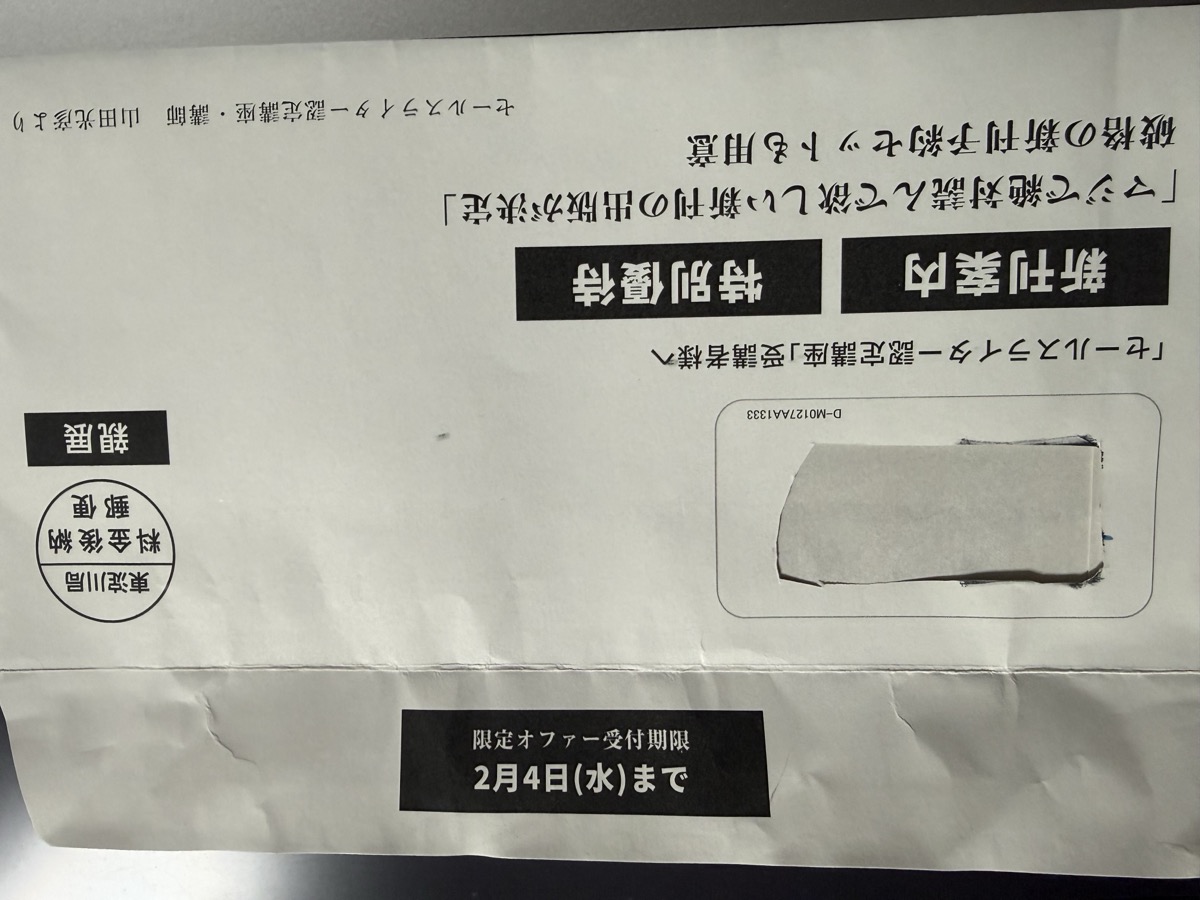
What I received was a plain white envelope.
But if you look closely, there's a red label on it.
“Limited Offer Deadline: 2/4 (Wed)”
With just these characters, an alarm starts sounding in the brain.
This“Deadline effect”It's a psychological phenomenon called.
The moment the human brain recognizes that “there is a deadline,” the quality of judgment declines. This is because the “let's think about it later” option disappears. There are only a few days left until February 4. Impatience that “I have to decide now” develops unknowingly.
Plus the word “limited.”
This“scarcity bias”It's a trigger that activates. People value “things they might not be able to get” above their actual value. In a 1975 psychological experiment, the evaluation of the taste of cookies went up just by being told “there are few left.” Even though it's the same cookie.
And one more thing. Being a paper envelope is itself a weapon.
If it's an email, you can delete it with 1 click. However, the active action of “throwing away” paper is necessary. Reaching for the trash can, that moment's hesitation. In that gap, the feeling of “why don't you open it for now” is born.
Three psychological triggers have already been set just on the surface of the envelope.
By the time you open it, the losing streak may have already started.
[1st sheet/surface] The moment you open it, “God” speaks to you
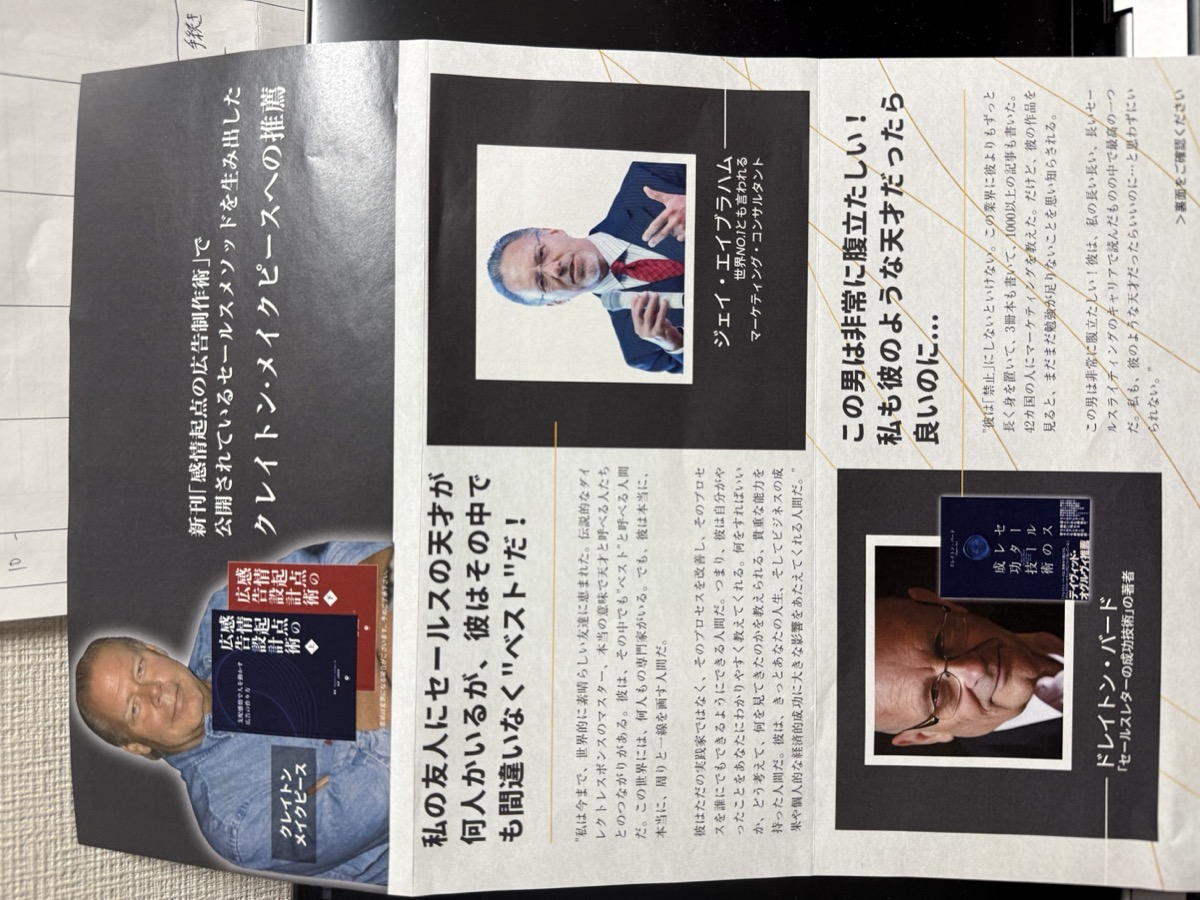
The first thing you see after opening the seal is Clayton Makepeace's face and book.
Letters of recommendation for the person who created the sales method published in the new book “The Art of Creating Advertisements Starting from Emotions” are lined up.
Jay Abraham. Drayton Byrd.
They are people called “world No. 1” in the marketing world.
Their recommendations are strong.
“I have several sales geniuses among my friends, and he's definitely the “best” of them all!” “This guy is so infuriating! I wish I was a genius like him...”
What is happening in your brain the moment you see this?
“Hierarchy of Authority”is working.
Recommended by “the world's No. 1 marketing consultant.” Moreover, it is a comparative expression of “the best among several geniuses.”
It's easier for people to believe if they are compared to “number 1 among A, B, and C” rather than being told “number 1.” Specific comparisons amplify persuasive power.
Also, expressions of jealousy such as “infuriating” and “I wish I were a genius.”
This“Paradoxical recommendation”that's it.
Rather than a normal compliment, the nuance of “I'm frustrated but I have no choice but to admit it” sounds more like real intention. It's not a made-up compliment; it's a design that makes you feel that way.
[1st image, back side] The moment you open it, a flood of authority
The first thing you see after opening the seal is the title “Notice from The Response Office.”
And numbers pop into your eyes.
“85% off”
Normally, I would think “it's a bargain sale,” but this paper doesn't let me do that.
“As a special benefit for those who participate in the sales writer certification course...”
This is the point.
It's not “why don't you buy it because it's cheap?”“Since you are an elected person, you have special rights”That's framing.
This“In-group bias”I'm using it.
People tend to make favorable judgments about “the group they belong to.” If you are aware that you belong to a group called “people who participated in certification courses,” it becomes difficult to refuse “special offers for that group.”
It's not shopping. They exercise their privileges.
Even with the same “85% off,” the way you receive it completely changes with just one way to communicate.
[1st page, back side] Damaging trust due to a flood of authority
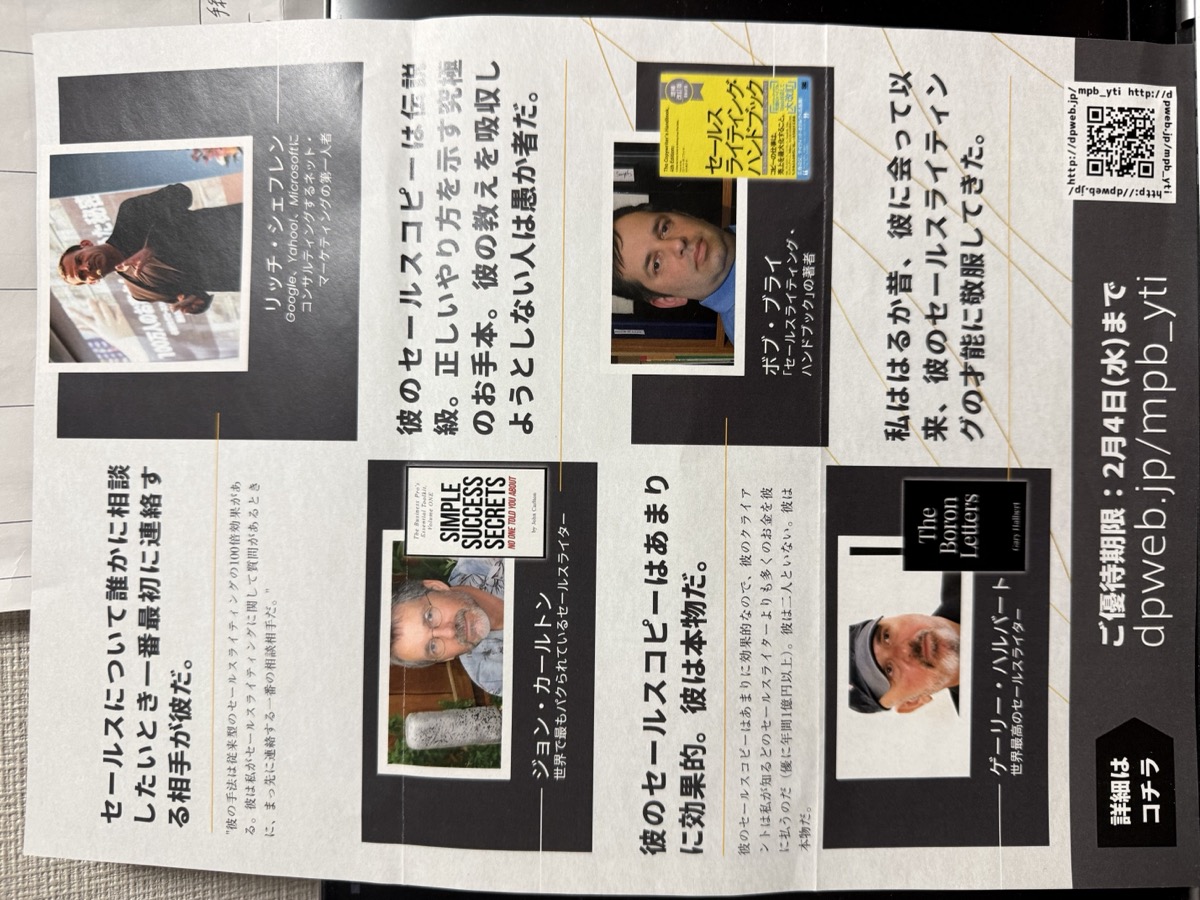
When turned over, photos of the faces of 4 more people are lined up.
Rich Schefflen. John Carlton. Bob Bligh. Gary Halbert.
They are people called “legends” in the sales writing world.
“When I want to talk to someone about sales, he is the first person I contact.” “His sales copy is legendary. The ultimate example of how to do it right. People who don't try to absorb his teachings are fools.” “His sales copy is so effective. He's real.” “Since I met him a long time ago, I've admired his sales writing talent.”
The recommendation for the “God Class” is shown on the front side, and the “Legend Class” further drives them down on the back.
This“Building up social proof”that's it.
The fact that “everyone is saying it” is a shortcut for human judgment. Even if you don't think about it yourself, you can draw a conclusion that “if this many people approve it, there's no doubt about it.”
Plus, it comes with a photo of your face.
Seeing a face increases the feeling that “a real person is really saying it” rather than a letter only recommendation. This“Face Effects”It is a phenomenon called, and reliability increases dramatically.
A total of 6 authority figures appeared on the front and back of a sheet of paper.
Why are 6 people lined up when even 1 person is enough?
The answer is simple. “I doubt it's alone. I believe there are 3 people. I'm sure it's 6 people” -- because that's how human cognition works.
[Second page, surface] Graphs speak louder than words
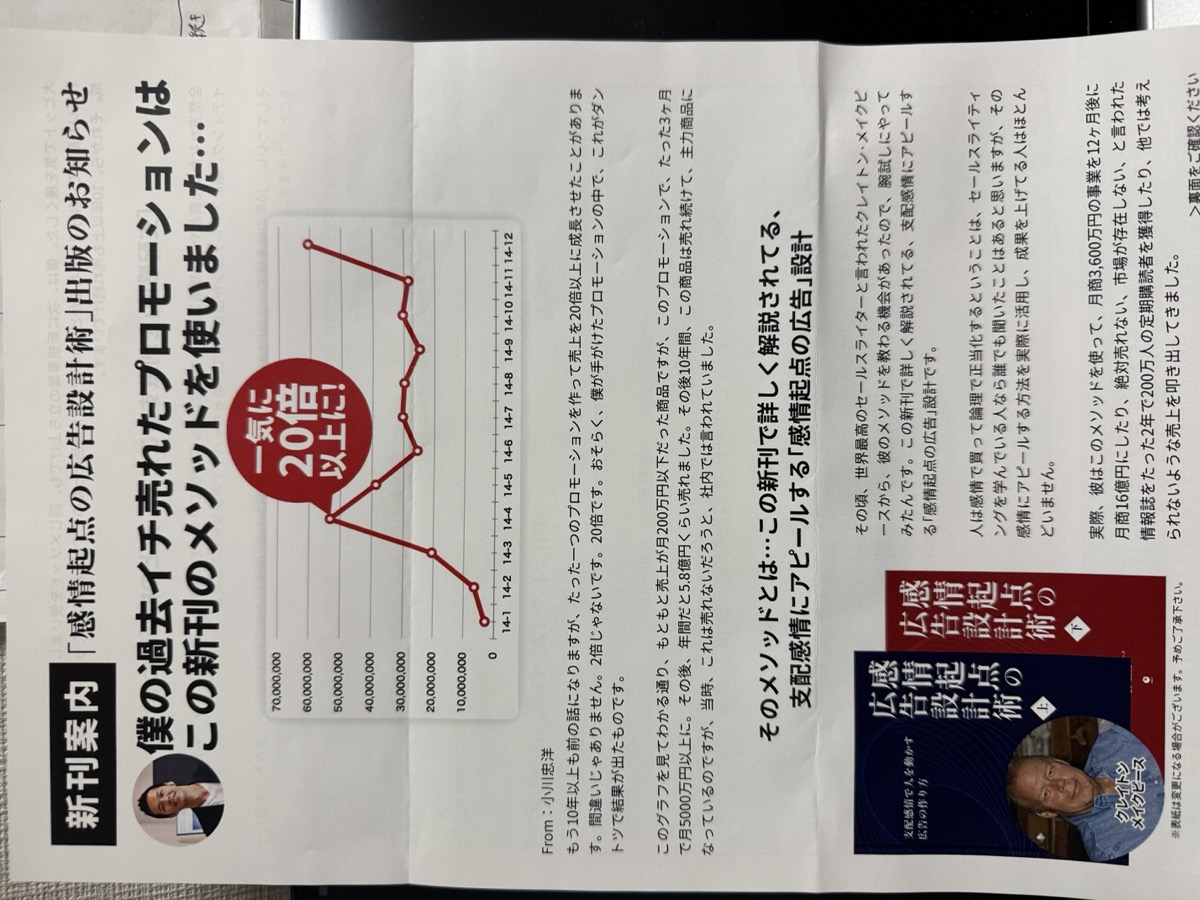
On the second table, you can see a graph that rises steadily.
“Over 20 times in one go!”
Rather than being told in words that “sales have increased 20 times,” I intuitively feel that it is “amazing” when shown in a graph.
This“The Power of Visual Evidence”that's it.
The human brain processes visual information at a higher speed than character information. Also, when you look at something “data-like” like a graph, it becomes easier to unknowingly accept it as an “objective fact.”
Actually, the details of the vertical and horizontal axes of this graph have not been confirmed. However, the brain immediately concludes that “rising steadily = success.”
And one more important thing“Narrative Effects”that's it.
“I used this new publication's method for my best-selling promotion in the past...”
There's not just data, there's a story.
Rather than an explanation that “this method is effective,” the story “this method produced the best results in the past” is many times more memorable. The brain likes stories over logic.
And readers unconsciously think this way.
“If this person were able to do it, I might be able to do it too”
This is the trigger for the purchase.
[2nd sheet, back side] The “invisible reference point” of 210,000 yen
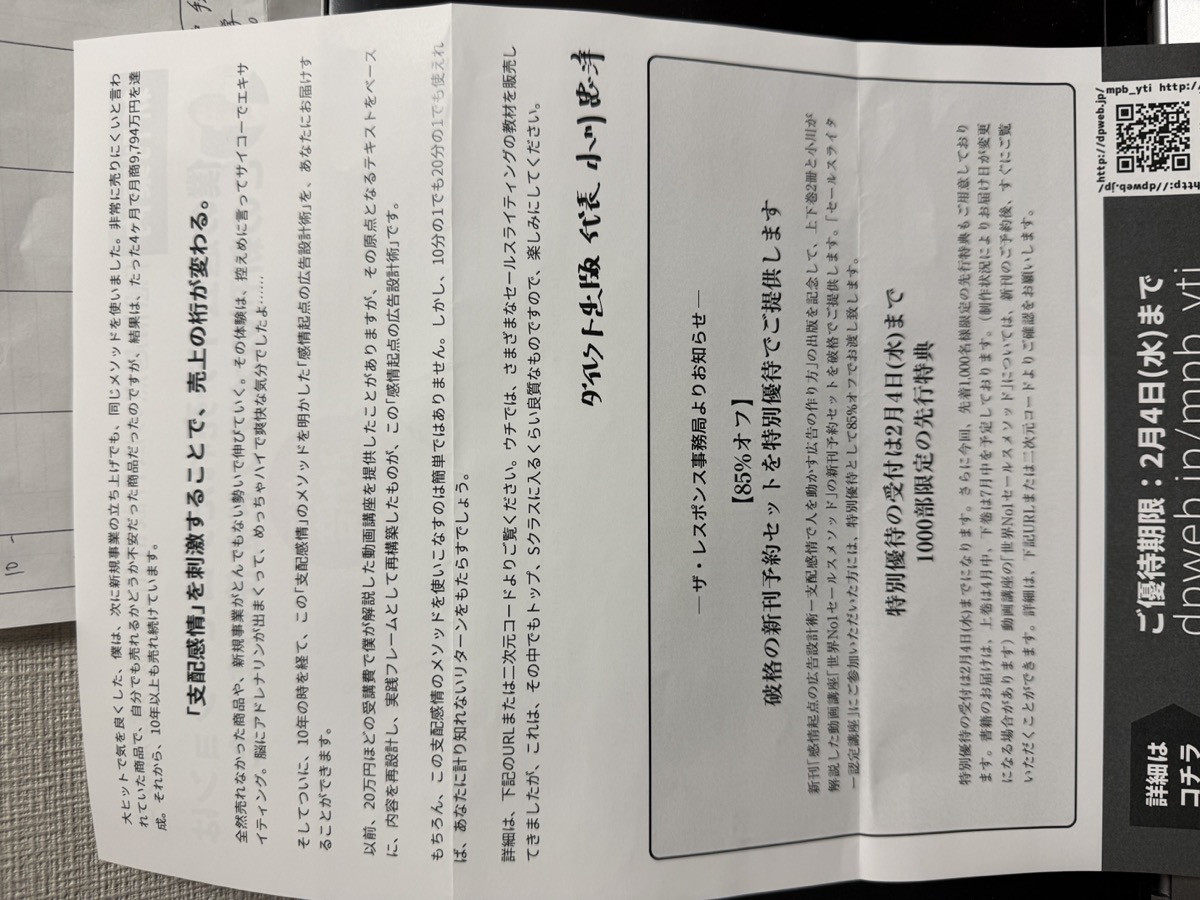
When I turn it over, a bold copy jumps into my eyes.
By stimulating “control sentiment,” the order of sales changes.
And then the specific numbers continue.
“We achieved monthly sales of 97.94 million yen in just 4 months. Since then, it has continued to sell for over 10 years.”
What is being used here“Law of specificity”that's it.
I feel that “monthly sales of 99.94 million yen” are more credible than “sales have gone up.” When there is a fraction, the brain determines “this is real data.” Not 98 million yen, but 99.4 million yen. This difference of 60,000 yen creates reality.
What is even more clever is how to lower the hurdles.
“If you can use 1/10 or 1/20, it will bring you an immeasurable return.”
This“Adjusting Expectations”That's a technique.
People hesitate when they think “it's meaningless if you don't master it perfectly.” However, when they say “it's OK if you can use it even a little bit,” the psychological hurdle drops all at once.
And then the last bad push.
“This is of such good quality that it is at the top and in the S class among them.”
Among our productsrelative evaluationBy showing it, it instills the impression that “this is special.” We compare our company, not our competitors'. So it's not disgusting.
[3rd sheet/surface] The “invisible reference point” of 210,000 yen
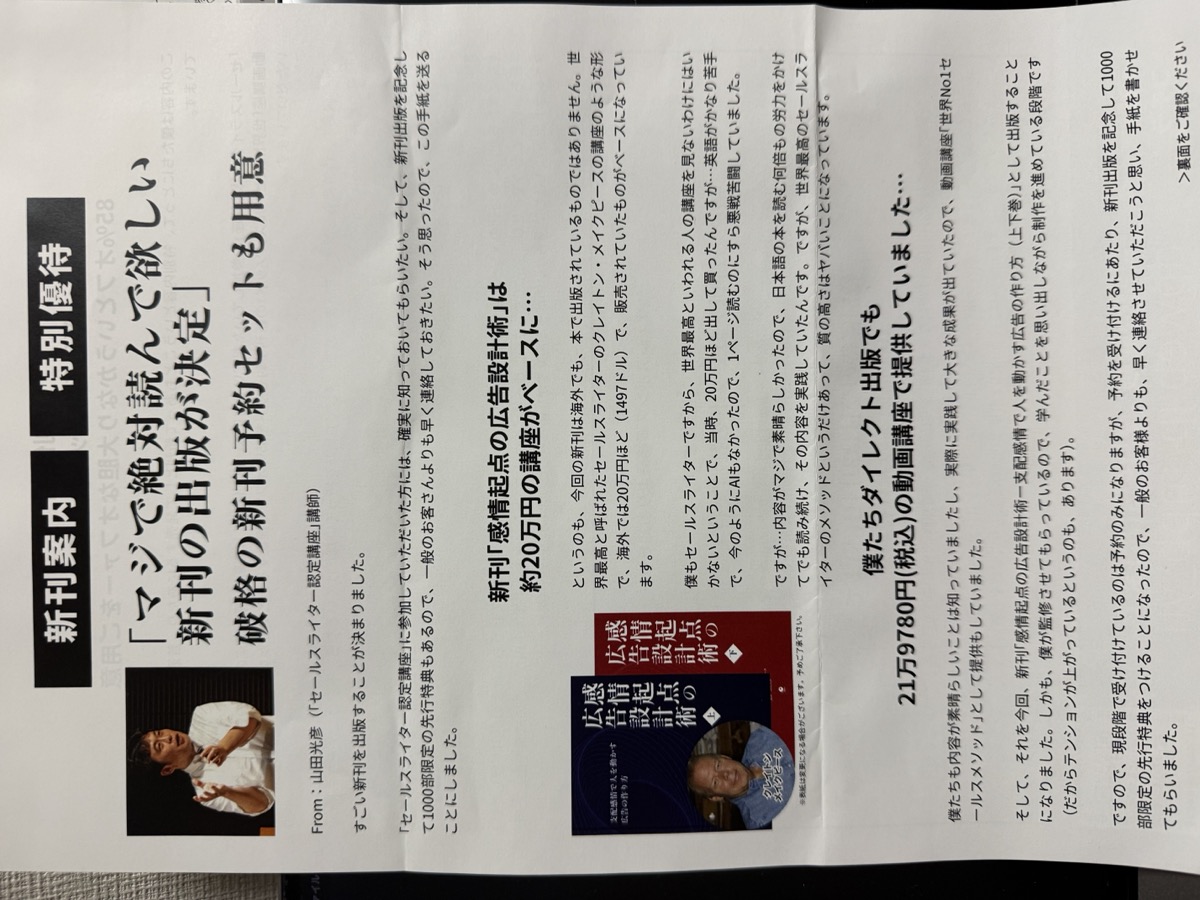
When you turn it over, there is a number that suddenly jumps into your eyes.
“219,780 yen”
I doubt my eyes for a moment. expensive.
But this is the trap.
The moment you see this number, a “reference point” is driven into the brain. In psychology“Anchoring effect”It's a phenomenon called.
The first number presented becomes the standard for all subsequent judgments.
After this, no matter what price comes out, it will be judged by “how it compares to 210,000 yen.” If I were told 30,000 yen, I would feel that “I also gained 180,000 yen.” Even if it's 50,000 yen, it's a “160,000 yen deal.”
If you think about it calmly, you should determine “whether it's worth 30,000 yen.” But the brain starts calculating “how much was deducted from 210,000 yen” without permission.
Also, there is another trick to this paper.
“Seriously, I definitely want you to read it”
this broken expression. It's not like an ad. It's like LINE from a friend.
This is intentional. The moment they recognize “it's an advertisement,” the person goes into defensive mode. But if you think it's a “recommendation from a friend,” your guard will drop.
Colloquial language is the strongest weapon to eliminate sales pitch odors.
[3rd image, back side] The last recommendation is in “Postscript”
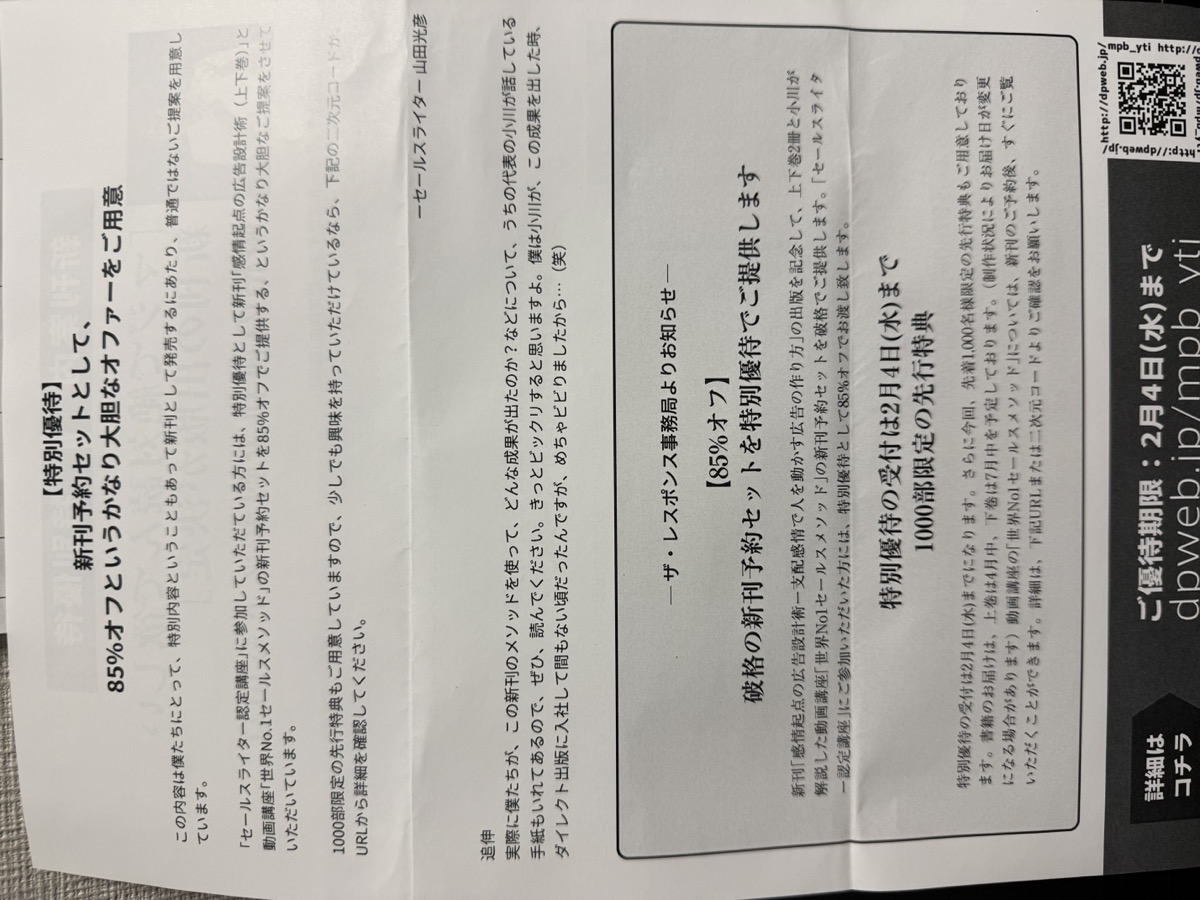
The third sheet is a letter-style sales letter.
There is a “special discount” and “a pretty bold offer of 85% off” at the beginning, and Yamada Mitsuhiko signed at the end.
And then there's a postscript.
P.S.: What kind of results did we actually achieve by using this newly published method? There is also a letter in which our representative, Ogawa, talks about things like that, so be sure to read them. I'm sure you'll be surprised. I had just joined Direct Publishing when Ogawa achieved these results, and I was really scared... (laughs)
Why bother writing in “postscript”?
The answer is simple. The postscript can be read from the main text.
When given long sentences, people only read “first” and “last.” The middle is read fluently. Therefore, in the world of direct response, it is an imperative rule to place important things at the beginning and postscript.
Also, the content of the postscript is a “story about results.”
Here it is called “limited to 1000 copies”scarcityand “until 2/4”deadlinewill reappear.
The information I saw in the envelope is reminded again at the end. This repetition fuels action.
Why “this order”
If you sort out the structure of this DM, it looks like this.
[Envelopes] Instill a sense of anticipation and urgency ↓[First sheet/table] Build trust with the authority of the “God” class ↓[1st sheet, back] Bad press for authority in the “Legend” class ↓[Second sheet, table] Arouse desire with graphs and performance stories ↓[2nd sheet, back] Imprint the value of the method with “controlling feelings” ↓[3rd sheet/table] Type in expensive anchors and lower your guard in colloquial language ↓[3rd card, back] Call to action with a postscript
Have you noticed?
The reader's psychology is guided in the order of “trust → desire → conviction → action.”
First, it makes me think, “If these people say it, they seem trustworthy.” Next, it makes me think, “If such results come out, I want them.” Also, the number “210,000 yen is 85% off” convinces them that “if you don't buy it now, it's a loss.” Finally, let them act “Let's apply now.”
A state where “there is no reason not to buy” is created before the reader thinks “I want to buy it.”
This is the “design” of direct response marketing.
I think the person who made this DM is a real professional
Each sheet has its meaning. The order also has meaning. The wording also has meaning. Nothing is a coincidence.
210,000 yen is 85% off. Limited to 1000 copies. Until 2/4. Recommended by global sales writers. If you were showered with this much “design,” it's natural for your brain to shake.
However, when I verbalize “why am I trying to buy it,” the way I see it changes.
“Because it's a good deal,” “because it's limited,” and “because everyone recommends it” — these are all “reasons” set up by the seller. It's not a reason that springs from within me.
If you know behavioral economics, you can notice where your judgments are distorted.
If you notice it, you can choose. If you don't notice it, you'll be swept away.
Do you know or don't you know? That much difference changes the contents of the wallet.
What I felt once again through this DM analysis
The essence of marketing is “design.”
Right now, while building a system with vibe coding, I'm designing sales letter writing and running advertisement operations. Then, the numbers are deciphered through quantitative analysis using Claude Code, and the next improvement points are searched.
“Make,” “write,” “spin,” and “analyze” — there are still not many people who can do all these four at once.
In the past, how many people were needed to make this happen?
1 engineer. 1 copywriter. 1 person in charge of advertising operations. 1 data analyst. At least 4 people. If you think about labor costs, it's a team that costs 2 to 3 million yen a month.
Now, if you make full use of AI, even just one person can run it.
Of course, AI isn't magic. In order to master it, it is necessary to know the “key points” of each area. But conversely, if you hold the key points, AI will boost the execution part many times over.
Code is written ten times faster. There are opponents who hit the lighting wall 24 hours a day. SQL statements for data analysis can be generated in an instant. You can submit an infinite number of A/B test proposals for ad creatives.
There is a possibility that 1 person can generate value for 4 people.
That's why this combination is worth it.
Even if each skill isn't special, it becomes rare when combined. And AI takes that combination to a level where it can be realistically rotated. I think market value is something that is created in this way.
Going forward, we will continue to refine this “design ability” through various projects. And what I noticed during that process, I intend to leave it on my blog in this way.